
Workshop & systems
Vent outside or filter? Define the decision before choosing equipment
Venting and filtration are not interchangeable product labels. Define what the process creates, how it will be captured and moved, where air will go, how performance will be checked and what happens when evidence is missing.
The direct answer
Do not choose “vent outside” or “buy a purifier” from a generic rule. Start with the exact machine, material, process, room and applicable duties. Build one route from capture to safe discharge or documented filtration, including maintenance and verification. If the evidence cannot show that route controls exposure, stop and obtain competent advice.
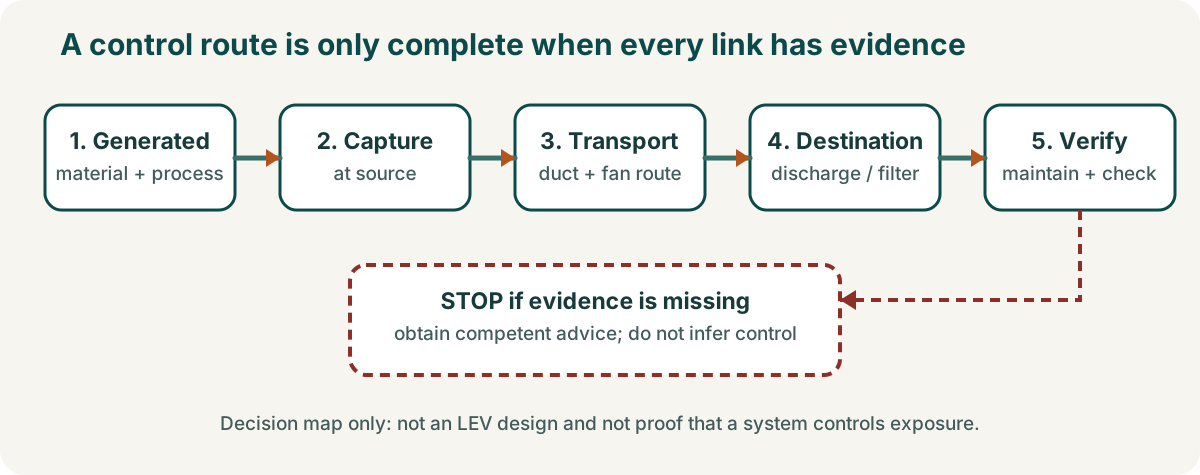
The decision has five parts
| Part | Evidence to collect | Stop condition |
|---|---|---|
| What is generated | Exact material/product and process evidence | Unknown composition or unresolved harmful by-products |
| Capture | Exact machine enclosure/outlet and manufacturer requirements | No evidence that emissions are captured at source |
| Transport | Duct, fan, bends, length and installation requirements | Generic fan claim substituted for the actual route |
| Destination | Discharge location or filter scope and compatibility | Recirculation/discharge accepted without evidence |
| Verification/maintenance | Checks, filter state, cleaning/replacement and responsible person | No way to know when control has degraded |
HSE says bought-in LEV should be fit for purpose and capable of adequately controlling exposure.1 That principle requires a complete, verifiable control route; this page does not design one remotely.
Why a filter name is not a finished answer
Manufacturer support material can specify compatible devices, exhaust arrangements and maintenance actions for exact products.2 Treat that as model-specific evidence, not proof that a different machine, material, room or filter configuration is suitable.
Write the decision record
- Name the exact machine/configuration and materials.
- Record the manufacturer’s exhaust and accessory requirements.
- Map capture, duct/connection, destination and room constraints.
- Record what the filtration evidence actually covers.
- Define checks, maintenance and who acts on failure.
- Mark every unresolved item UNKNOWN and stop where it is consequential.
Sources
- HSE, Clearing the air, INDG408. Used for fit-for-purpose, adequate-control and safe-disposal principles.
- xTool Support, poor smoke evacuation for xTool P2; and Air Purifier 2 FAQs. Exact-product manufacturer examples only; not independent control verification.
- HSE, COSHH risk assessment. Used for considering harmful substances created by a process and selecting controls.